

NC State University Institute for Emerging Issues LogoNC State University Institute for Emerging Issues LogoInstitute for Emerging Issues

Support Donate Today! Support
  • About
    • About IEI
    • Staff
    • 2021-22 National Advisory Board
      • 2021-22 National Advisory Board
      • Member Page
    • IEI Event Space
    • Support IEI
    • Job Opportunities
  • Emerging Issues Forums
    • Advancing Together: The 2022 Emerging Issues Forum
    • ReCONNECT NC
    • Past Forums
  • Initiatives
    • BAND-NC
    • Civic Conversations
    • KidsReadyNC
    • PILOT 21
    • Project Resilience
    • Rural Faith Communities
    • Past Initiatives
      • Discovery Forum
      • InnovateNC: A Cross-City Learning Collaborative
      • Service Year
      • Text, Talk, Future
  • Media
    • Articles
    • Emerging Issues Podcasts
    • Digest
    • Press Releases
  • Resources
    • Connecting in Crisis: COVID-19
    • Connecting in Crisis: Digital Inclusion Information Exchange
    • Reconnect County Snapshot
    • Local Financing for Early Childhood
    • InnovateNC: A Cross-City Learning Collaborative
    • FutureWork Disruption Index
    • 2015 NC Civic Health Index
    • Manufacturing Toolkit
    • NC County Health Tool
Search
  • facebook
  • youtube
  • twitter
  • instagram
  • linkedin
Explore Elkin banner

Five Communities: Explore Elkin

By Staff | November 5, 2018 Newswire

For the upcoming ReCONNECT to Community forum, Nov. 27 in Asheville, the Institute for Emerging Issues has chosen five community initiatives throughout North Carolina that will share with our forum audience how they’re working to increase civic engagement in their communities. Here, we profile Explore Elkin, an initiative started by the Surry County community to promote civic engagement as the former mill town evolves economically.

John Cheek’s downtown Elkin coffee shop lived former lives as a hair salon, a license plate office and possibly a church.

The tobacco fields surrounding the town have turned into vineyards.

Like many rural North Carolina communities, Elkin, located about 45 minutes west of Winston-Salem, has been busy reinventing itself and the town wants people, including its own citizens, to know all about it.

That’s why Cheek and other Elkin residents have become “Explorers,” supporters of the town’s “Explore Elkin” initiative, which through recreational events, gatherings and a dynamic website is working to foster community engagement in this historic mill town that has become so much more.

For one thing the mill, Chatham Manufacturing, is mostly gone, and the town’s other historic employer, Vaughn Bassett Furniture (formerly Elkin Furniture Company) has also closed its local manufacturing operation. What’s left in Elkin are can-do residents, a burgeoning wine industry, a vibrant local music scene and a much-loved trail system between two state parks and the beautiful Yadkin River. While manufacturing still plays an important role in this small Appalachian foothills community, the days of one company driving the local economy are over and economic diversification is critical for future growth.

“We’re helping people re-explore what’s right here,” said Leslie Schlender, the Town of Elkin’s economic director. “We need to realize what’s unique about ourselves, build on it, and also work with what’s changing.”

Unfortunately, the changes the town saw in the last half century took many residents like Cheek away.

“Many of my generation had to leave the town if they wanted to find work,” said Cheek, 52, who ran coffee shops throughout the Southeast before returning to Elkin two years ago to be near family.

He’s one of the 350 “Explorers” who’s annual fees help fund community events. Cheek calls the fees, which have raised $55,000 so far, reasonable and says Explore Elkin adds to the town’s progressive image and shows it as a place moving forward. “It takes the whole community for a town to be successful,“ Cheek said.

Explore Elkin also creates connection between the town’s citizens, said Cheek, who noted the socioeconomic diversity of the “Explorers”.  All this leads to healthier civic engagement.
One of the group’s meetings.

“When you’re wanting civic engagement, you can’t always go about it in a traditional way,” Schlender said. “Recreation is a huge platform for civic engagement.”

The Explore Elkin team is excited for the even larger platform of the ReCONNECT to Community forum, where Elkin Commissioner Jeff Eidson, a member of the initiative’s founding committee, will take the stage to tell the Explore Elkin story.

“We feel we can learn much from the other ReCONNECT NC communities at the forum. We also hope to obtain insight on how to better promote diversity and engage those citizens who have historically been under represented in broad community initiatives,” Eidson said.
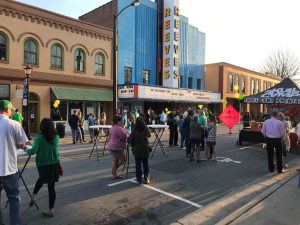
St. Patrick’s Day Block Party at Elkin’s Reeves Theater before a Celtic concert.


To learn more about Explore Elkin, visit exploreelkin.com.

To learn more about the ReCONNECT to Community forum, visit emergingissues.org.

–Beth Hatcher

Published in Newswire.
Tags: Civic Engagement, Communities, ReCONNECT to Community

Staff Spotlight: Simone Collman, Event Coordinator IEI First in Future 100th EPISODE: Anita Brown-Graham

Share

Facebook Twitter LinkedIn Email

Other Top News


Institute for
Emerging Issues

NC State University
Centennial Campus

919.515.7741
919.513.7535 (fax)

emergingissues@ncsu.edu


Physical Address:
James B. Hunt, Jr. Library
1070 Partners Way
Raleigh, NC 27606

Mailing Address:
Institute for Emerging Issues
NC State University
Centennial Campus Box 7406
Raleigh, NC 27695

Visit Us

Quick Links

BAND-NC
Podcasts
Rural Faith Communities
Emerging Issues Forum
Sign up for IEI emails
  • facebook
  • youtube
  • twitter
  • instagram
  • linkedin
Institute for Emerging Issues
  • Copyright © 2026
  • · NC State University
  • · Accessibility
  • · Privacy
  • · University Policies
  • · Log in
NC State University
North Carolina State University Raleigh, NC 27695 919.515.2011

David Brooks is an Op-Ed columnist for The New York Times, a position he began in September 2003, as well as an Executive Director at the Aspen Institute. He is currently a commentator on “The PBS Newshour,” NPR’s “All Things Considered” and NBC’s “Meet the Press.”

He is the author of “Bobos In Paradise: The New Upper Class and How They Got There” and “The Social Animal: The Hidden Sources of Love, Character, and Achievement.” In April of 2015 he came out with his fourth book, “The Road to Character,” which was a number 1 New York Times bestseller. Mr. Brooks also teaches at Yale University and is a member of the American Academy of Arts & Sciences.

Dr. Darin J. Waters is the Executive Director of the Office of Community Engagement, and an Associate Professor of History at UNC Asheville in Asheville, North Carolina. As a professor, Dr. Waters teaches courses in American history, North Carolina History, Appalachian History, African American and Brazilian History. He also specializes in the history of race relations in both the United States and Latin America. In his role as the Executive Director of the UNC Asheville Office of Community Engagement, Waters works closely with campus and community leaders, representing an array of community-based organizations, to strengthen and build new partnerships for and with the university.

Waters is the co-host of The Waters and Harvey Show on Blue Ridge Public Radio. He currently serves as a member of The North Carolina Historic Markers Commission, the board of the National Blue Ridge Heritage Area, the board of the Thomas Wolfe Memorial of Historic Asheville, and the North Carolina Civil War History Center. Find out more about his work at darinwaters.com.

Mary Lou Addor serves as the NC Sentinel Landscapes Partnership & Adjunct Assistant Professor out of NC State University. Addor is a leader in the areas of leadership and professional development, facilitation and public participation, conflict management, team building, negotiation and coaching. She is the former director of the Natural Resources Leadership Institute. She is concerned with the ongoing, systematic process of implementing effective organizational change.